Two Staffs
On a confusion that has defined a century of medicine.
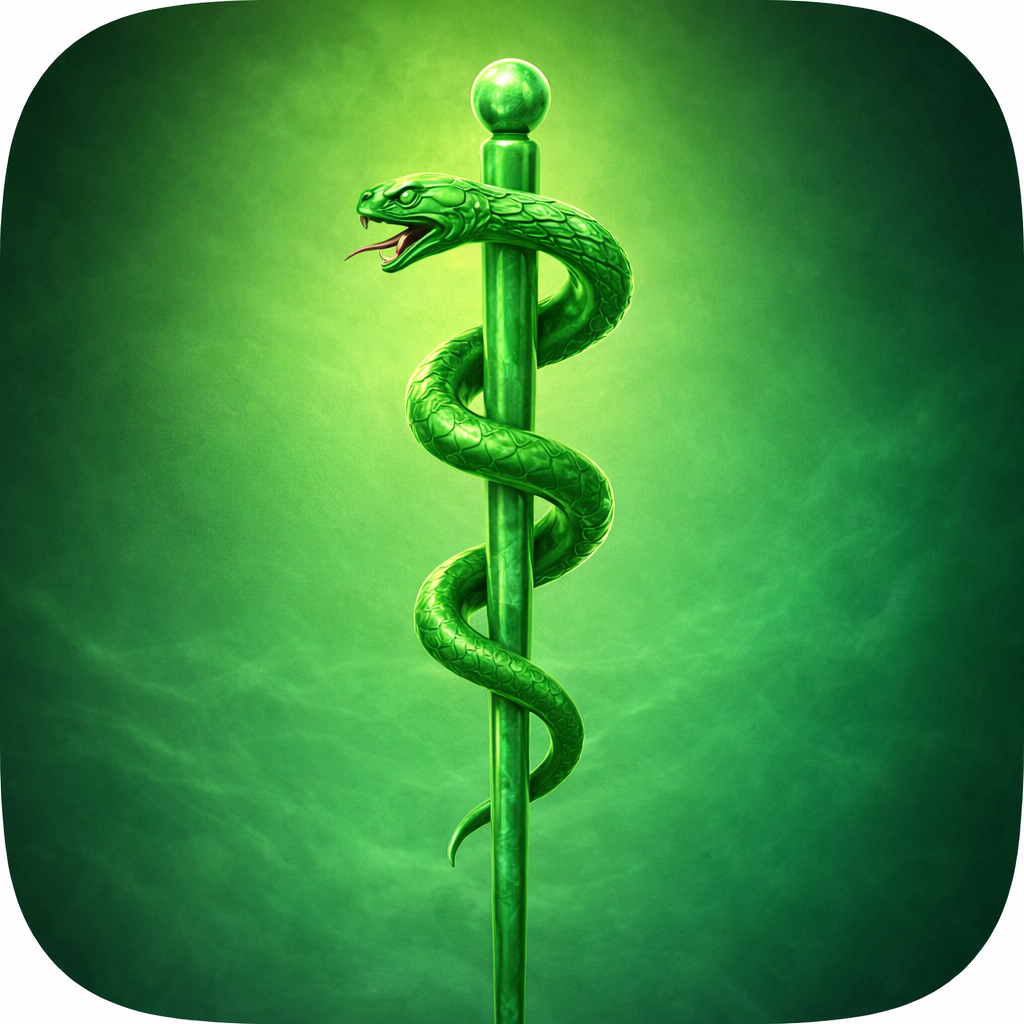
THE ROD OF ASCLEPIUS — staff of the healer, symbol of medicine's actual lineage.
Two staffs. One erasure.
There are two staffs in the history of Western medicine, and they are not the same thing. The first belongs to Asclepius — the healer, the physician, the son of Apollo who learned the art of resurrection. His staff is plain: a single serpent coiled around a rough-hewn rod. No wings. No ornamentation. Just the snake, which sheds its skin and returns renewed, wrapped around the instrument of the one who could raise the dead.
The second staff belongs to Hermes — god of commerce, thieves, travelers, and eloquent liars. His caduceus carries two snakes and a pair of wings, because Hermes moves fast and trades in both directions. He is not a healer. He is a messenger. He escorts souls to the underworld. The two staffs could not be more different in meaning.
— Medical historian Stuart L. Tyson, 1932
In 1902, the United States Army Medical Corps adopted the caduceus — Hermes' staff — as its symbol. The decision was administrative, not scholarly. A clerical officer liked the look of it. Within decades the error had propagated into hospitals, pharmacies, insurance companies, and medical schools across the country. Today, the staff of the god of thieves adorns the institutions of healing, while the true staff of Asclepius is used primarily by the World Health Organization, the American Medical Association, and those who bothered to check.
The error persists not because anyone defended it but because no one wanted to correct it. Correction requires admitting the mistake. Correction requires undoing decades of letterhead and signage and institutional identity. The wrong symbol became load-bearing.
Asclepius and the thirteenth sign
Asclepius — Ophiuchus in the sky — is the serpent-bearer. He stands at the ecliptic holding a serpent, a creature that connects death and renewal, that sheds what no longer serves it and continues. He is a healer who was killed for healing too well.
He was placed among the stars because Zeus killed him. The story varies by source, but the core holds: Asclepius learned to resurrect the dead. He succeeded. The natural order was disrupted — souls that were meant to reach the underworld did not arrive. Hades complained. Zeus, enforcing the boundary between life and death, struck Asclepius down with a thunderbolt. Then, in apparent recognition of the injustice, placed him in the heavens as the constellation ⛎ Ophiuchus.
For most of recorded history, Ophiuchus was counted among the zodiacal constellations — the ones the sun passes through. Aratus counted him. Hipparchus counted him. Ptolemy documented the sun's passage through his constellation in the Almagest. He was present. He was counted. He was there.
The Babylonians chose twelve. Twelve is divisible. Twelve fits a lunar calendar. Twelve is clean. So they counted the constellations once, and excluded Ophiuchus, and handed the system to the Greeks, who handed it to Rome, who handed it to the medieval world, who handed it to us. The healer was cut from the record not because he was absent from the sky but because twelve is a more convenient number than thirteen.
The IAU — the International Astronomical Union — redrew the constellation boundaries in 1930, using Eugène Delporte's precise demarcations. Under those boundaries, the sun spends approximately eighteen days per year passing through Ophiuchus, between November 29 and December 17. This is not disputed. It is observable. The ecliptic passes through his constellation for eighteen days and no one who uses a modern star atlas would argue otherwise. He is still there. He is still being excluded.
This is why Crossroads exists. The true sky does not round to the nearest comfortable answer. The boundaries are not arbitrary — they are the IAU boundaries, the same ones every professional astronomer uses, derived from actual stellar positions against the actual ecliptic. If the sun was in Ophiuchus when you were born, your chart says Ophiuchus. If it was in Scorpius for nine days instead of the traditional thirty, your chart says nine days. The sky does not negotiate.
The rod that remains
The Rod of Asclepius is not lost. It appears on the flag of the World Health Organization, on the seal of the American Medical Association, and in the iconography of most international medical bodies outside the United States. It persists in the margins — correct, uncelebrated, recognized by those who checked.
Ophiuchus carries it still. He stands at the boundary of Scorpius and Sagittarius, holding Serpens, the sun passing through his constellation for eighteen days each year. He was cut from the zodiac for the inconvenience of his knowledge. Some boundaries are maintained not by physics, but by preference.
If you have found yourself reading this far, you are paying attention. Paying attention is the only prerequisite. The sky rewards it. So does this application. Those who look at the same symbol three times — really look, not just glance — find that the threshold opens. The healer, after all, only helps those who are willing to be seen.
Sources and further reading:
Tyson, Stuart L. "The Caduceus." The Scientific Monthly, vol. 34, no. 1, 1932, pp. 82–86.
Wilcox, R.A. and Whitham, E.M. "The symbol of modern medicine: why one snake is more than two." Annals of Internal Medicine, 138(8), 2003.
Ptolemy. Almagest, Book VIII. Translated by G.J. Toomer, Princeton University Press, 1998.
Delporte, Eugène. Délimitation scientifique des constellations. Cambridge University Press, 1930.
IAU constellation boundaries: iau.org